
🍔🧠 Why Spotify Ditched Monolithic Ad Logic (Multi-Agent Breakdown)
PLUS: 114 system design concepts 👨💻, Agent memory systems 💾, SWE AI stack 2026 👨💻

Happy Monday! ☀️
Welcome to the 412 new hungry minds who have joined us since last Monday!
If you aren’t subscribed yet, join smart, curious, and hungry folks by subscribing here.

📚 Software Engineering Articles
Two years of vector search at Notion: 10x scale, 1/10th cost
How Codex is built: inside OpenAI’s code generation engine
Master 114 system design concepts everyone needs to know
How GPUs communicate for AI workloads at scale
Clinejection: prompt injection turned into supply chain attack
🗞️ Tech and AI Trends
OpenAI launches Frontier: build and deploy AI agents enterprise-wide
Gemini 3.1 Pro is here with massive upgrades
Seedance 2.0 AI video generation reaches wild new heights
👨🏻💻 Coding Tip
CSS container queries adapt components to their parent’s size, not the viewport, enabling truly reusable design systems

How Spotify Built a Multi-Agent System to Automate Media Planning 🤖
Spotify’s ads business had a structural problem: multiple buying channels (Direct, Self-Serve, Programmatic) all running on shared infrastructure but with fragmented, duplicated logic. Media planning required advertisers to manually configure 20+ form fields, often without insight into what actually works. They needed a unified decision layer.
The challenge: Create a system that understands natural language campaign goals, reasons over historical performance data, and orchestrates existing APIs consistently across all buying channels—without becoming a brittle rules engine.
Implementation highlights:
RouterAgent as traffic cop: Fast first-pass routing analyzes user intent and determines what information is present, preventing unnecessary LLM calls
Specialized resolution agents in parallel: GoalResolverAgent, AudienceResolverAgent, BudgetAgent, and ScheduleAgent each handle one dimension of the problem simultaneously
MediaPlannerAgent with heuristics engine: Optimizes recommendations using seven weighted rules (cost, delivery rate, budget matching, duration, targeting overlap, format diversity, budget-based scaling)
Tools as grounding mechanism: Function calling gives agents access to real data—geo targets, ad categories, historical performance—preventing hallucinations
Strict prompt guardrails: Treat prompts as code with explicit format requirements, concrete examples, and parsing-layer validation for consistency
Results and learnings:
60-180x faster: Media plan creation dropped from 15-30 minutes to 5-10 seconds with data-driven recommendations backing every suggestion
Prompt engineering is software engineering: Version control your prompts, test them rigorously, and iterate like code—wording changes dramatically shift LLM consistency
Agent boundaries matter: One agent per distinct skill or data source prevents monolithic prompts and keeps latency tight through parallelization
Spotify’s approach proves that agentic architectures excel at decomposing combinatorial, multi-step workflows. By treating complex problems as a choreography of specialized agents with clear responsibilities, they created something that scales across channels without duplicating logic.

Two years of vector search at Notion: 10x scale, 1/10th cost
This is the story of how we scaled our vector search infrastructure by 10x while simultaneously reducing costs by 90 percent over the past two years.
How Codex is built
Written by Gergely Orosz

I struggled with system design until I learned these 114 concepts
Written by Neo Kim

AI in Multiple GPUs: How GPUs Communicate
A deep dive into the hardware infrastructure that enables multi-GPU communication for AI workloads
Software Is Dead — Long Live Software
“SaaSmageddon,” Vertical AI & the Vibe Code Fallacy
Software engineer’s AI stack in 2026
Written by Fran Soto

ARTICLE (sneaky code ninjas)
How “Clinejection” Turned an AI Bot into a Supply Chain Attack GITHUB
REPO (agents chatting nicely)
Symplex, an open-source protocol semantic negotiation between distributed agents
ARTICLE (robots building robots)
OpenAI Introduces Harness Engineering: Codex Agents Power Large‑Scale Software Development
ESSENTIAL (right now matters)
What Developers Actually Need to Know Right Now
ARTICLE (ai everywhere go brrrr)
The path to ubiquitous AI
ARTICLE (zen code vibes)
A virtual Zen garden for vibe coding
ARTICLE (remember all the things)
How we built Agent Builder’s memory system
ARTICLE (level up your squad)
Learning Tracks: Become an Engineering Multiplier
Want to reach 200,000+ engineers?
Let’s work together! Whether it’s your product, service, or event, we’d love to help you connect with this awesome community.

🤖 Sam “Claws” Attention Back OpenAI (5 min)
Brief: OpenAI’s CEO Sam Altman hired Peter Steinberger, the developer behind viral open-source AI agent OpenClaw, to lead the company’s coding tools division and compete with Anthropic’s Claude Code, while also beating out Meta’s competing offer and positioning OpenAI for a stronger IPO narrative around autonomous agents.
🤖 OpenAI Launches Frontier, an Enterprise Platform for Building and Managing AI Agents (2 min)
Brief: OpenAI introduces Frontier, an enterprise platform designed to help companies build, deploy, and manage AI agents at scale by providing shared business context, institutional knowledge onboarding, and identity governance—while allowing organizations to integrate existing systems without replacement, though some users express concerns about vendor lock-in and the shift toward enterprise-focused AI products.
🧠 Google Launches Gemini 3.1 Pro: A Smarter AI Model for Complex Problem-Solving (4 min)
Brief: Google releases Gemini 3.1 Pro, an upgraded AI model with advanced reasoning capabilities that doubles the performance of its predecessor on complex logic benchmarks, now available to developers, enterprises, and consumers through the Gemini API, Vertex AI, the Gemini app, and NotebookLM.
🤖 How AI is Affecting Productivity and Jobs in Europe (5 min)
Brief: A study of over 12,000 European firms reveals AI adoption boosts labour productivity by 4% on average without reducing employment in the short term, but gains are unevenly distributed—medium and large firms benefit most, while complementary investments in training and data infrastructure are critical to unlocking AI’s full potential.
🔧 How Taalas “Prints” LLM Onto a Chip for 17,000 Tokens Per Second (4 min)
Brief: Startup Taalas released a custom ASIC chip that runs Llama 3.1 8B at 17,000 tokens per second by physically etching model weights into silicon, eliminating the memory bandwidth bottleneck that plagues GPUs and achieving 10x faster inference with 10x lower cost and energy consumption.
🎬 Seedance 2.0 AI Video Model Shifts Focus to Cinematic Coherence Over Raw Visual Novelty (4 min)
Brief: As AI video generation evolves, Seedance 2.0 emerges as a model prioritizing temporal stability, camera movement, and scene-level coherence over isolated visual moments, signaling industry-wide expectations toward motion consistency and workflow integration that can support real creative production rather than standalone clips.

This week’s tip:
Use CSS container queries with @container to build truly responsive components that adapt to their parent’s width/height, not just viewport size, enabling reusable component libraries that work at any scale. Pair with custom properties and @supports to progressively enhance designs without breaking older layouts.
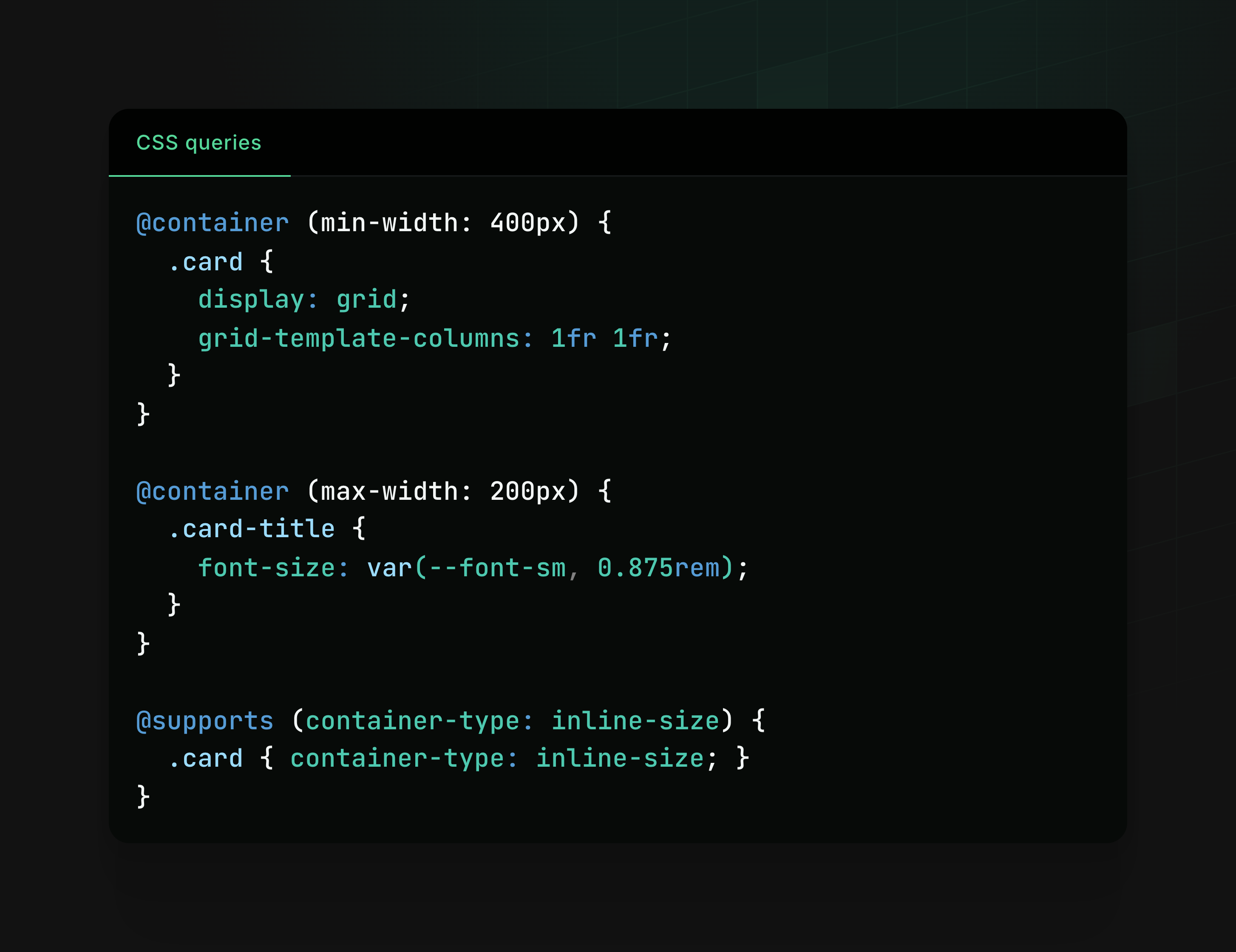
Wen?
Component library design systems: Cards, panels, sidebars adapt to their container’s width regardless of viewport; a card in a 300px sidebar sizes differently than in a full-width grid cell, without multiple responsive breakpoints.
Compositional layouts with multi-column grids: Subgrid + container queries let child components query their direct parent, enabling nested layouts (sidebar + main with embedded cards) to reflow intelligently without media query duplication.
Progressive enhancement: Fallback to grid or flex layouts for unsupported browsers; @supports (container-type) ensures that missing container query support doesn’t break layouts, just disables the responsive behavior.
FOCUS - Follow One Course Until Successful
Robert Kiyosaki

That’s it for today! ☀️
Enjoyed this issue? Send it to your friends here to sign up, or share it on Twitter!
If you want to submit a section to the newsletter or tell us what you think about today’s issue, reply to this email or DM me on Twitter! 🐦
Thanks for spending part of your Monday morning with Hungry Minds.
See you in a week — Alex.
Icons by Icons8.