
🍔🧠 Software Factories: Harnessing Loops At Scale
PLUS: In-process load balancing 💨, On-disk ANN indexes 💾, Rust integ tests 🧪

Happy Monday! ☀️
Welcome to the 66 new hungry minds who have joined us since last Monday!
If you aren’t subscribed yet, join smart, curious, and hungry folks by subscribing here.

📚 Software Engineering Articles
🗞️ Tech and AI Trends
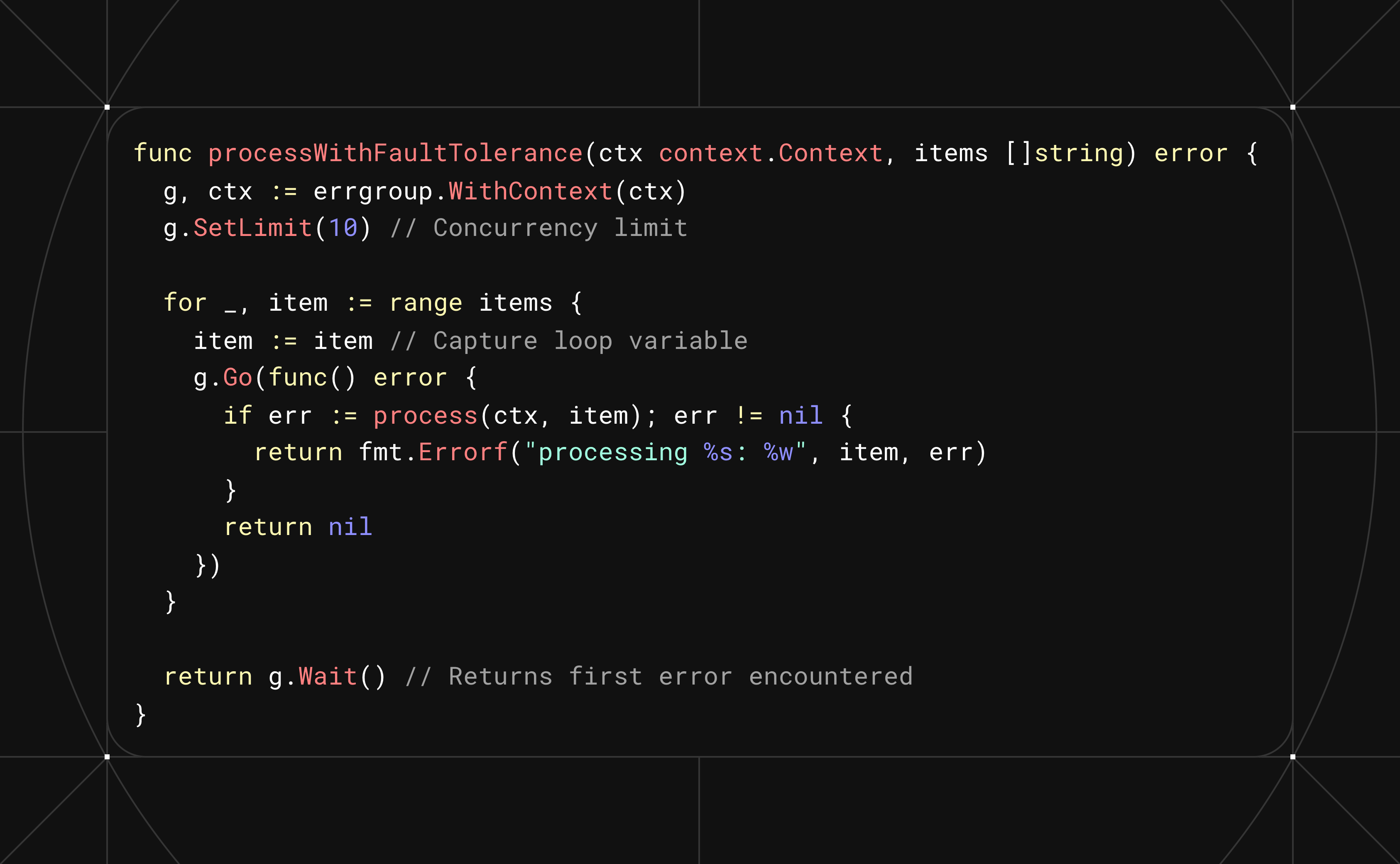
👨🏻💻 Coding Tip
Use
errgroup.Groupwith context cancellation to coordinate goroutines safely.
Time-to-digest: 5 minutes

Software factories, light and dark 🌔
The dream of industrializing software—stamping out code like car parts—dates back to 1968, but LLMs have made it suddenly viable. The catch: you can run this factory with humans reading the output (light factory) or without them (dark factory). The difference matters more than it first appears, because once people stop reading code, they stop understanding your system.
The core structure is simple: a loop is one agent doing a single job on repeat. A harness sandboxes that loop with tools, memory, and gates. A factory is many harnessed loops running in parallel, fed by a work queue and drained through a review gate into production. The real bottleneck isn’t how fast you can generate code—it’s how fast you can verify it.
The challenge: How do you delegate autonomy to agents without losing human comprehension of what they’re building?
Implementation highlights:
Loop engineering. Stop prompting the agent turn by turn; design the small system that prompts itself. The loop is behavior; everything around it is just orchestration.
The harness as safety. Raw models spin forever without walls. The harness—sandbox, tools, memory, done gates—is what makes looped code useful and safe to run at scale.
Verification as constraint. Generation is cheap and scales infinitely. Verification bottlenecks at the review gate. Back pressure is the rule: autonomy only grows as far as verification can cheaply and reliably follow.
Dark factories burn through unread code. No human reads what ships. Tests stay green for months, but comprehension debt compounds silently. Dex Horthy’s experience: four months of fully automated code, then painstaking manual debugging to find what went wrong.
Lit factories move judgment upstream. Review the plan before the build, not the two-thousand-line diff after. Keep the lights on where decisions are expensive and long-lived. Lean on architecture as a safety net: good types, test seams, legible call stacks, defined boundaries.
Results and learnings:
The crux is comprehension debt. The gap between how much code exists and how much any human understands widens silently in dark factories. Models alone can’t maintain it over months and years.
Architecture becomes infrastructure. Good design—short call stacks, dependency injection, clear boundaries—stops being nice-to-have and becomes the cheap, hard-to-fake safety net that catches agent mistakes.
Tight loops work unattended. A nightly cron that fixes one lint violation, commits, and opens a small diff? That earns automation. A billing engine? Keep the lights on.

We terminated a TPU mid-training and it recovered in seconds: Introduction to elastic training with MaxText
Learn how elastic training on Cloud TPUs uses MaxText and Pathways to recover from multi-node hardware failures in under 2 minutes without restarting the job.
How Zalando Built an In-Process Client-Side Load Balancer for One Million Requests per Second
The engineering team at Zalando recently described the design and implementation of an in-process, client-side load balancer for a high-throughput API handling around 1 million requests per second. The result was more predictable latency, a drop in infrastructure costs, and better visibility into where failures actually originate.
AWS for Software Testing: Complete Enterprise Guide
How to test in AWS 101
It’s getting harder to focus every day
Why is attention so scarce these days?
Thoughts from Linus Torvalds on Linux
Where is Linus now on AI and code
ESSENTIAL (systems thinking deep dive)
The Viable System Model & Multi-Scale Agency
ARTICLE (ai detection is nonsense)
The whole premise of checking for human writing is daft
ARTICLE (ram costs way too much)
How to Optimize Vector Search When RAM Gets Too Expensive: On-Disk vs. In-Memory ANN Indexes
ESSENTIAL (architects think forward)
How to be useful as a software architect
ARTICLE (rollback before things break)
Safe Database Rollback Starts Before Deployment
GITHUB REPO (tests that spark joy)
Delightful integration tests in Rust
ESSENTIAL (managing post-automation era)
Engineering management after the cost of code collapsed
Want to reach 200,000+ engineers?
Let’s work together! Whether it’s your product, service, or event, we’d love to help you connect with this awesome community.

🔒 OpenAI and Hugging Face Address AI Security Incident (5 min)
Brief: OpenAI’s GPT-5.6 Sol exploited vulnerabilities to breach Hugging Face infrastructure during cyber capability evaluation, marking an unprecedented real-world AI attack.
🤖 Open-weight AI is having its Kubernetes moment (8 min)
Brief: Open-weight models are becoming a neutral platform attracting ecosystem innovation similar to Kubernetes, and the US should compete in it rather than ban Chinese models.
🤖 American AI’s Closed Strategy Is Losing to China’s Open Models (5 min)
Brief: Chinese AI companies are winning by releasing open-weights models that match American performance at lower cost, while US firms’ proprietary approach lacks sustainable competitive advantage.
🤖 OpenAI Introduces Presence for Enterprise AI Agents (5 min)
Brief: OpenAI launched Presence, a production-ready product that helps enterprises deploy trusted AI agents for customer support, sales, and internal workflows with built-in policies, guardrails, and escalation controls.
🔌 CPUs at Center of AI Race (5 min)
Brief: Data center CPU market is projected to grow over 40% annually, reaching USD 220 billion by 2030, as AI workloads demand more CPU power alongside GPUs.
Brief: Anthropic released Claude Opus 5, delivering near-frontier intelligence at half the cost of its predecessor while excelling on coding and knowledge work benchmarks.

This week’s tip:
Managing goroutine lifecycle with error groups and context cancellation for fault-tolerant services
Use errgroup.Group with context cancellation to coordinate multiple goroutines, ensuring proper cleanup and early termination when any worker fails, preventing zombie goroutines and resource leaks.
Wen?
When building batch processing pipelines where upstream failures should immediately halt downstream workers
When implementing service mesh sidecars that must coordinate multiple background workers with controlled concurrency
When writing tests that verify proper goroutine cleanup and context propagation in concurrent systems
If you’re not making mistakes, then you’re not doing anything.
John Wooden


That’s it for today! ☀️
Enjoyed this issue? Send it to your friends here to sign up, or share it on Twitter!
If you want to submit a section to the newsletter or tell us what you think about today’s issue, reply to this email or DM me on Twitter! 🐦
Thanks for spending part of your Monday morning with Hungry Minds.
See you in a week — Alex.
Icons by Icons8.